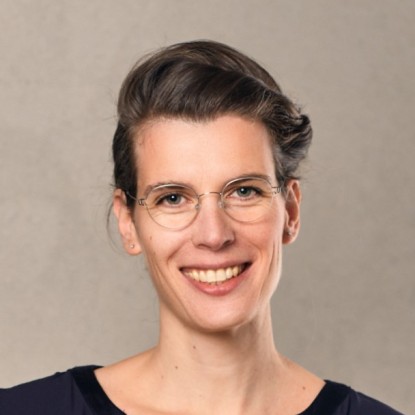
New at the Department: Professor Michael Sedlmair
2026/10/01 by Die Fragen stellte Patrick Bal
The Department welcomes Michael Sedlmair as Professor of “Visual Computing” in the Department of Computer Science. This appointment was made in collaboration with the Fraunhofer Institute for Computer Graphics Research IGD, where Professor Sedlmair will also serve as Director of the Institute in addition to his professorship at TU Darmstadt.

The 45-year-old researcher is moving to Darmstadt from the University of Stuttgart. He cites establishing his own internationally recognised research group and being appointed to a W3 professorship at the University of Stuttgart as significant academic and professional milestones. Other milestones include his pioneering work on situated analytics and AR and XR visualisation, and his significant contributions to the research community through projects such as VIS30K, vispubdata and keyword analyses. He has also achieved a consistent stream of top-tier publications and Best Paper awards at the field’s leading conferences.
To mark his start at TU Darmstadt, we asked Professor Sedlmair a few questions:
Why should students be interested in your research topics? What makes them so fascinating?
Visual computing is one of the most exciting areas of computer science for me because it is incredibly diverse and at the heart of many technological breakthroughs. Data visualisation and visual analytics help us to understand complex relationships; they are, in a sense, the microscopes and telescopes of data-driven research and development.'
Virtual and augmented reality (VR/AR) could be the next generation of displays. Perhaps one day we’ll all be wearing smart glasses instead of smartphones. Computer vision is fundamental to autonomous vehicles, medical image analysis and robotics, while computer graphics ensure that virtual content looks realistic. AI has already changed our world, and visual computing is now bringing this intelligence into the physical and visual worlds from the purely textual realm. I believe this will be one of the next major technological trends.
At TU Darmstadt, interdisciplinarity is a top priority. Where do you see overlaps with other disciplines in your field of work?
Pretty much everywhere. And that’s exactly what makes the subject so exciting. Visual computing links computer science with a wide variety of disciplines, such as computer vision with robotics or medicine, VR and AR with psychology, design or architecture, computer graphics with media studies, and visualisation with practically every field in which data is generated. Visualisation is a prime example of this: we collaborate with experts in biology, engineering, climate research and many other fields to solve their specific problems. Therefore, a large part of my research has always involved successfully organising such interdisciplinary projects. This has given rise to the Design Study Methodology, an approach that demonstrates how computer science and applied research can collaborate to develop improved solutions.
Which department at TU would you like to spend a day getting to know? Why?
Ideally, all of them – that’s one of the great advantages of a university. If I had to choose one off the top of my head, it would probably be Civil and Environmental Engineering. If I had to choose one off the top of my head, it would probably be the Department of Civil and Environmental Engineering. This department addresses some of the most significant challenges of our time, ranging from sustainable construction to climate change. I’m already closely connected to this field through the IntCDC Cluster of Excellence in Stuttgart, and I’d be delighted to expand this collaboration further in Darmstadt. I’m convinced that combining engineering and computer science will lead to many more exciting solutions.
If I were a student today, I would …
… probably pause for a moment to consider whether I should study maths, physics, music or something completely different after all – simply because there are so many fascinating subjects. But I would end up back in computer science fairly quickly. For me, it is the key technology of our time. Hardly any other subject has such a profound impact on science, business and society, whilst at the same time featuring in almost every other discipline. Anyone who studies computer science is therefore not choosing a single field of application, but rather a tool with which they can make a difference in almost every area. That’s exactly what inspired me back then – and I see that now more than ever.
The best way to unwind after a stressful day at work is …
… quite clearly: spending time with my family – my wife and our three children. Next comes cycling, preferably outdoors in nature and ideally with a few hills. And music: playing in a band with friends is one of the few moments when I’m guaranteed not to be thinking about university. At least, almost never (side note: we also carry out research projects combining visualisation and music).
Disclaimer: AI-assisted translation