Fake news and disinformation campaigns are increasingly spoiling the web's information integrity. AI has accelerated that development through deepfakes and other cheap generation techniques. An adequate response requires scalable automated fact-checking. The development of such systems is the main focus of this award- and challenge-winning research initiative – which counts to the world's frontier on automated fact-checking research.
Research HiWi for Multimodal Fact-Checking
Join the fight against disinformation with challenge- and award-winning researchers in AI-based fact-checking! In this application-oriented student research assistant position, you will contribute to the world-leading development of automated approaches to advance society towards higher information integrity.
Highlights
VeriTaS (🏅 Best Resource Paper Award)
With VeriTaS, we introduced the first dynamic benchmark for multimodal automated fact-checking. It received the Best Resource Paper Award from ACL 2026, which places it among the top 0.25% of more than 12,000 submissions. VeriTaS aims to set a new evaluation standard for MAFC systems by providing high-quality, multimodal, multilingual claims from real-world fact-checks. Learn more on the VeriTaS project page.


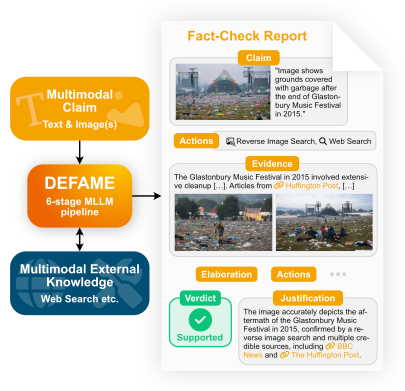
DEFAME is the first multimodal fact-checking system that can handle both multimodal claims and multimodal evidence. It was the leading SOTA on four different benchmarks. Read the paper or check out the GitHub repository.

InFact (🏆 Challenge Winner)
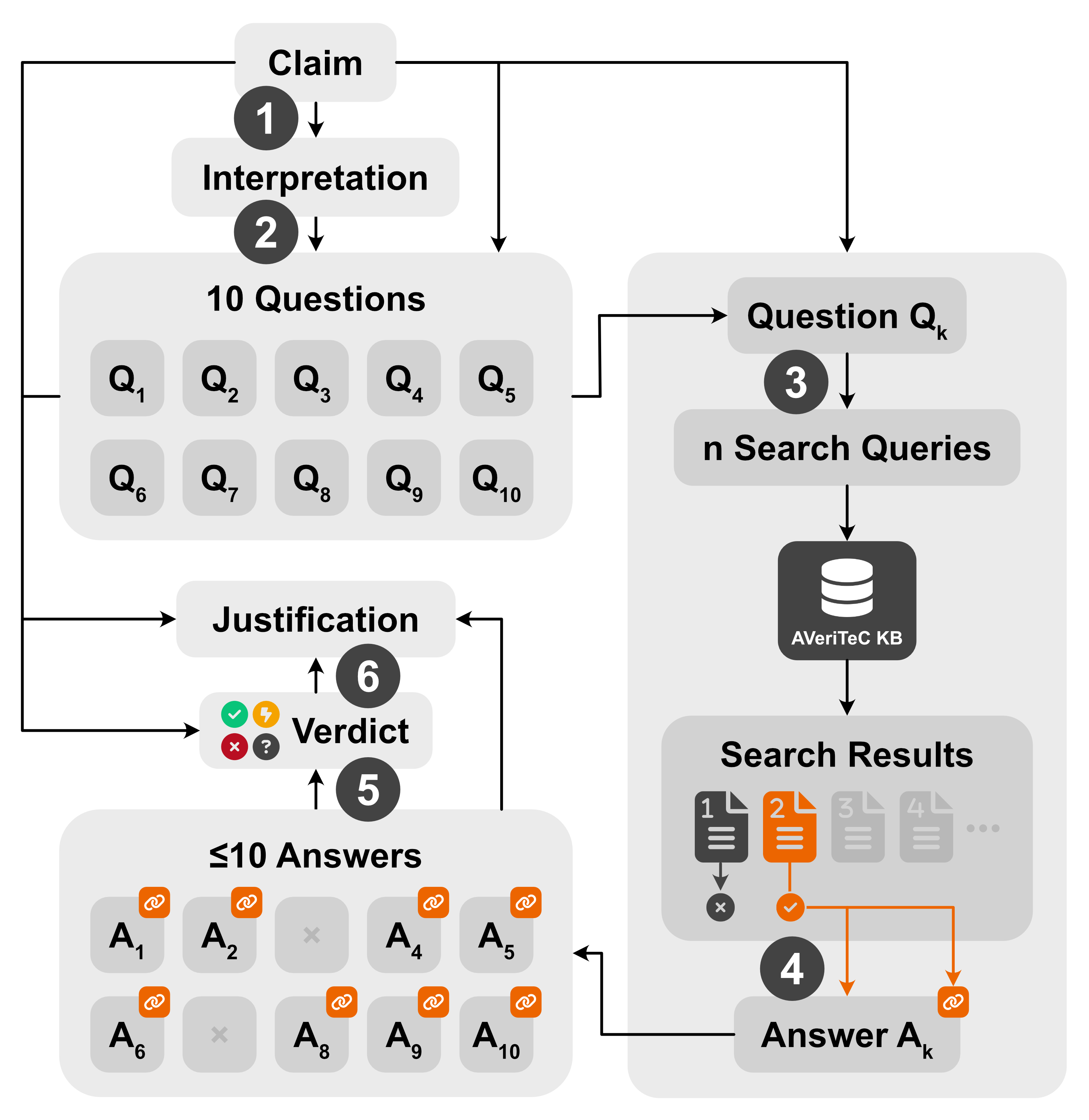
InFact is the text-only fact-checking system with which we won the 2024 AVeriTeC challenge against 20 other teams. We published the details in the system description paper. The code is publicly accessible on GitHub.
Research Lead

Mark Rothermel M.Sc.
Multimodal AI
Multimodal Grounded Learning
Contact
mark.rothermel@tu-...
Work
S4/23 207
Landwehrstr. 50A
64293
Darmstadt
The Problem of Fact-Checking
Multimodal Automated Fact-Checking (MAFC) is the task of identifying and verifying the informational integrity of any input content. It may contain text, images, videos, and audio. MAFC encompasses a wide range of subtasks that can be roughly grouped into two supertasks:
Claim Extraction
Given, for example, a social media post, the Claim Extraction supertask aims to distill the factually verifiable, check-worthy, and unchecked claims from the raw content. It involves
- Content Interpretation: Identify the author’s core statement(s) and intent. Ground the content in the available context (who posted it, when was it posted, etc.), resolve the role of contained media (images, video, audio), and handle ambiguities
- Claim Decomposition: Sometimes referred to as “Claim Normalization”. Split the author’s statements into smaller/atomic facts that are easier to handle.
- Claim Filtering: Keep only the statements that are actual claims, i.e., that are factually verifiable. For example, remove all opinions
- Checkworthiness Estimation: Determine the relevance/need for the claims to be fact-checked. Claims vary in terms of impact, dissemination, harmfulness, etc. As we cannot fact-check everything on the web, we need to prioritize checkworthy claims.
- Claim Matching: Compare the claim to a database of already checked claims to avoid redundant fact-checking. This problem involves establishing a metric that efficiently measures the factual similarity of two syntactically different sentences.
Claim Verification
The Claim Verification supertask is the core of fact-checking. The goal is to ground the claim in retrieved evidence and predict its veracity. This involves the following subtasks:
- Evidence Retrieval: Integrate external tools such as search engines, geolocation, chronolocation, person identification, etc. that allow the retrieval of evidence. The retrieval of web sources also requires credibility estimation, evidence filtering/ranking, planning when to effectively and efficiently use which tool, etc.
- Reasoning: Apply inference methods such as Natural Language Inference (NLI) or a Knowledge Graph (KG) to elaborate/evaluate the claim in light of the retrieved evidence.
- Veracity Prediction: Given the retrieved evidence and reasoning, classify the claim’s veracity, typically supported, refuted, or NEI (not enough information).
- Justification Generation: Generate a concise explanation for the result to increase interpretability of the fact-check.
Interested in a Thesis?
Then please apply through our lab’s online application form. If capacity is available, we’ll explore topics for you and see if we can find one that matches your interests and skills.