-
![]() Picture: Yasemin Sevincli
Picture: Yasemin Sevincli![]() Picture: Yasemin Sevincli
Picture: Yasemin SevincliLearn more efficiently and save resources
2025/12/05
Research team develops method for accelerating reinforcement learning
Robots can learn to perform tasks. However, this learning process often requires large amounts of data and computing time. Researchers at TU Darmstadt have now developed an algorithm that works efficiently even with complex tasks. The research is part of the Cluster of Excellence “Reasonable Artificial Intelligence (RAI)”.
-
![]()
![]()
Today: Winter departmental colloquium and St. Nicholas celebration
2025/12/04
Drink vouchers for the first 50 students – have your student ID ready!
Once again this winter semester, the Department of Computer Science cordially invites its members, alumni and partners to the departmental colloquium in the large lecture hall C205. Take this opportunity to meet new professors, gain exciting insights into research in existing fields and exchange ideas.
-
![]() Picture: Susanne Schuckmann
Picture: Susanne Schuckmann![]() Picture: Susanne Schuckmann
Picture: Susanne SchuckmannFamily, care, studies – support services for pregnant women, student parents and carers
2025/11/03
Online information event on 14 November at 2 p.m. via Zoom
On Friday, 14 November 2025, from 2 p.m. to approx. 3 p.m., an online information event will be held via Zoom for pregnant students, students with children and students who care for relatives.
-
![]() Picture: Bild: TU Darmstadt/KI-generiert
Picture: Bild: TU Darmstadt/KI-generiert![]() Picture: Bild: TU Darmstadt/KI-generiert
Picture: Bild: TU Darmstadt/KI-generiertAI with Confidentiality
2025/10/13
Use of Artificial Intelligence in the Diagnosis and Treatment of Mental Disorders
Researchers led by Computer Science Professor Iryna Gurevych at TU Darmstadt and the Indian Institute of Technology (IIT) Delhi are addressing a key question: How can AI-based tools in the mental health domain be designed to reliably protect patient privacy? In a new study published in Nature Computational Science, they present a roadmap for developing support systems that improve diagnosis and therapy while safeguarding sensitive information. The researchers emphasize that privacy is a key prerequisite for using AI in mental health care.
-
![]()
![]()
New professor: Dr.-Ing. Katrin Hartwig
2025/09/30
Substitute professorship in Knowledge Engineering in the winter semester 2025/26
Dr Katrin Hartwig will take over as acting professor of Knowledge Engineering from 1 October for the 2025/26 winter semester. She is currently a research assistant and postdoctoral fellow in the Research Group ‘Science and Technology for Peace and Security’ (PEASEC). Her research focuses on human-computer interaction and usable security, particularly technical support for individuals and organisations in dealing with security-critical and crisis-relevant content, such as multimodal disinformation.
-
![]() Picture: Katrin Binner
Picture: Katrin Binner![]() Picture: Katrin Binner
Picture: Katrin BinnerA portrait of Athene Young Investigator Dr. Manisha Luthra Agnihotri
2025/09/17
The Athene Young Investigator Programme supports outstanding researchers on their way to professorship
Dr Manisha Luthra Agnihotri, Senior Researcher in Professor Carsten Binnig's research department 'Systemic AI for Decision Support' (SAIDE) and postdoctoral researcher in the Data and AI Systems group at the Department of Computer Science at TU Darmstadt, has been accepted into the Athene Young Investigator Programme at TU Darmstadt. The programme promotes the scientific independence of outstanding scientists at an early stage of their careers by enabling them to qualify for a professorship by independently leading a junior research group. We had the opportunity to talk to her and ask her a few questions.
-
![]() Picture: Stadtradeln/Klima-Bündnis/Felix Krammer
Picture: Stadtradeln/Klima-Bündnis/Felix Krammer![]() Picture: Stadtradeln/Klima-Bündnis/Felix Krammer
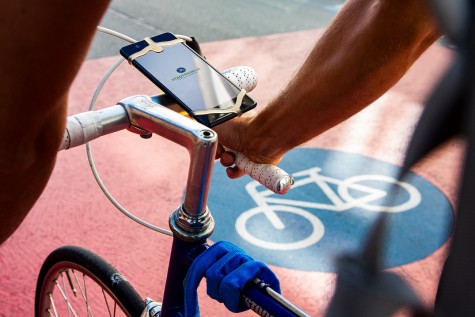
Picture: Stadtradeln/Klima-Bündnis/Felix KrammerCITY CYCLING 2025 – join our Computer Science team!
2025/09/08
The 8. edition of CITY CYCLING started on 7 September 2025 in Darmstadt.
-
![]() Picture: ATHENE/KI generiert
Picture: ATHENE/KI generiert![]() Picture: ATHENE/KI generiert
Picture: ATHENE/KI generiertNew study: systematically protecting submarine cables
2025/07/30
UNIDIR report with the participation of a TU computer scientist presents resilience model
Submarine internet cables are increasingly being classified as critical infrastructure internationally. However, until now, there has been no systematic investigation into the effectiveness of the various protective measures. Jonas Franken, a research assistant, doctoral student, and researcher at the department´s Research Group PEASEC and the ATHENE cybersecurity center, participated in a UNIDIR (United Nations Institute for Disarmament Research) study to address this issue.
-
![]() Picture: Katrin Binner
Picture: Katrin Binner![]() Picture: Katrin Binner
Picture: Katrin BinnerAlfried Krupp Award goes to robotics researcher Georgia Chalvatzaki
2025/07/04
TU computer scientist receives 1.1 million euros
Computer scientist Georgia Chalvatzaki has been awarded the 2025 Alfried Krupp Prize, one of the most prestigious scientific awards in Germany. The 37-year-old has held the position of Professor of Interactive Robot Perception and Learning in the Department of Computer Science at TU Darmstadt since 2023. A total of 42 nominations were received by the selection committee of the Alfried Krupp von Bohlen und Halbach Foundation from all over Germany. The Alfried Krupp Prize is endowed with €1.1 million.
-
![Portrait Prof. Dr. Mira Mezini]() Picture: hessian.AI
Picture: hessian.AI![Portrait Prof. Dr. Mira Mezini]() Picture: hessian.AI
Picture: hessian.AIComputer science professor Mira Mezini honoured with the Dahl Nygaard Prize
2025/07/02
Major award in the field of object-oriented software engineering
The prestigious Dahl-Nygaard Senior Prize 2025 will be awarded this year to Professor Dr. Mira Mezini from TU Darmstadt. The prize will be awarded tonight at this year's European Conference on Object Oriented Programming (ECOOP), which takes place from 30 June to 4 July. It honours her many years of pioneering contributions to software engineering.
-
![]() Picture: Adobe Stock / Alex / TUDa
Picture: Adobe Stock / Alex / TUDa![]() Picture: Adobe Stock / Alex / TUDa
Picture: Adobe Stock / Alex / TUDaTwo Clusters of Excellence for TU Darmstadt
2025/05/22
Department of Computer Science successful with RAI and TAM
A major success for Technical University of Darmstadt: two of its research projects will receive funding as Clusters of Excellence. The Excellence Commission in the competition for the prestigious Excellence Strategy of the German federal and state governments selected the proposals ‘Reasonable Artificial Intelligence’ (RAI) and ‘The Adaptive Mind’ (TAM) from the fields of artificial intelligence and cognitive sciences for funding. The commission consisted of an interdisciplinary panel of experts and the federal and state ministers responsible for science. A total of 98 projects were submitted to the German Research Foundation, 70 of which will now be able to call themselves ‘Clusters of Excellence’.
-
![]() Picture: PQCrypto
Picture: PQCrypto![]() Picture: PQCrypto
Picture: PQCryptoRecognition for Barbara Benedikt
2025/05/22
Doctoral Student Receives Paper Award at PQCrypto 2025
Doctoral student Barbara Benedikt from the research group Cryptography and Cryptoplexity Theory of Professor Marc Fischlin (TU Darmstadt) has been honoured with the recognition of “Best Young Researcher Paper” at the International Conference on Post-Quantum Cryptography (PQCrypto) 2025. The award was presented during the conference, which took place from 8th – 10th April 2025 at Academia Sinica in Taipei, Taiwan.
-
![]() Picture: chayapon - stock.adobe.com (KI generiert)
Picture: chayapon - stock.adobe.com (KI generiert)![]() Picture: chayapon - stock.adobe.com (KI generiert)
Picture: chayapon - stock.adobe.com (KI generiert)The Least Confident Delivery Drone Gets the Job
2025/05/20
Researchers from Technical University of Darmstadt and collaborators present a study
In the future, autonomous delivery drones could independently assess whether their remaining battery charge is sufficient for upcoming deliveries. A team of researchers from Technical University of Darmstadt and the University of Sheffield, in collaboration with the French National Institute for Research in Digital Science and Technology (INRIA) and industry partner Ingeniarius Ltd, has developed a new method for energy-aware deployment planning. The approach enables each drone to learn what orders it is capable of fulfilling even when not knowing its own battery health. It is shown to reduce delivery times and increase the number of processed orders compared to conventional approaches.
-
![]()
![]()
TU computer science professor Mira Mezini honoured with the Dahl Nygaard Prize
2025/05/07
Major award in the field of object-oriented software engineering
Der renommierte Dahl-Nygaard Senior Preis 2025 wird dieses Jahr an Professorin Dr.-Ing. Mira Mezini von der TU Darmstadt verliehen. Die Auszeichnung wird im Rahmen der diesjährigen European Conference on Object Oriented Programming (ECOOP) vergeben, die vom 30. Juni bis 4. Juli stattfindet. Damit werden ihre langjährigen, wegweisenden Beiträge zur Softwaretechnik gewürdigt.
-
![]()
![]()
Neu im Studiendekanat: Dr. Svana Esche
2025/04/04
Seit April unterstützt Dr. Svana Esche das Studiendekanat als wissenschaftliche Mitarbeiterin (Post-Doc) für Fachdidaktik. Esche schloss 2024 ihre Promotion mit Titel „Focus on Language in Introductory Programming“ am Fachgebiet Algorithmik bei Prof. Karsten Weihe ab. Neben ihrer Tätigkeit in Forschung und Grundlehre engagiert sich seit einigen Jahren im Gleichstellungsteam. Wir wünschen einen guten Start und haben ihr ein paar Fragen gestellt, um sie besser kennenzulernen.

Computer Science
News
Archive























Contact
Anne Grauenhorst, M. Sc.
Communication and Media Relations
anne.grauenhorst@tu-...
work +49 6151 16-25505